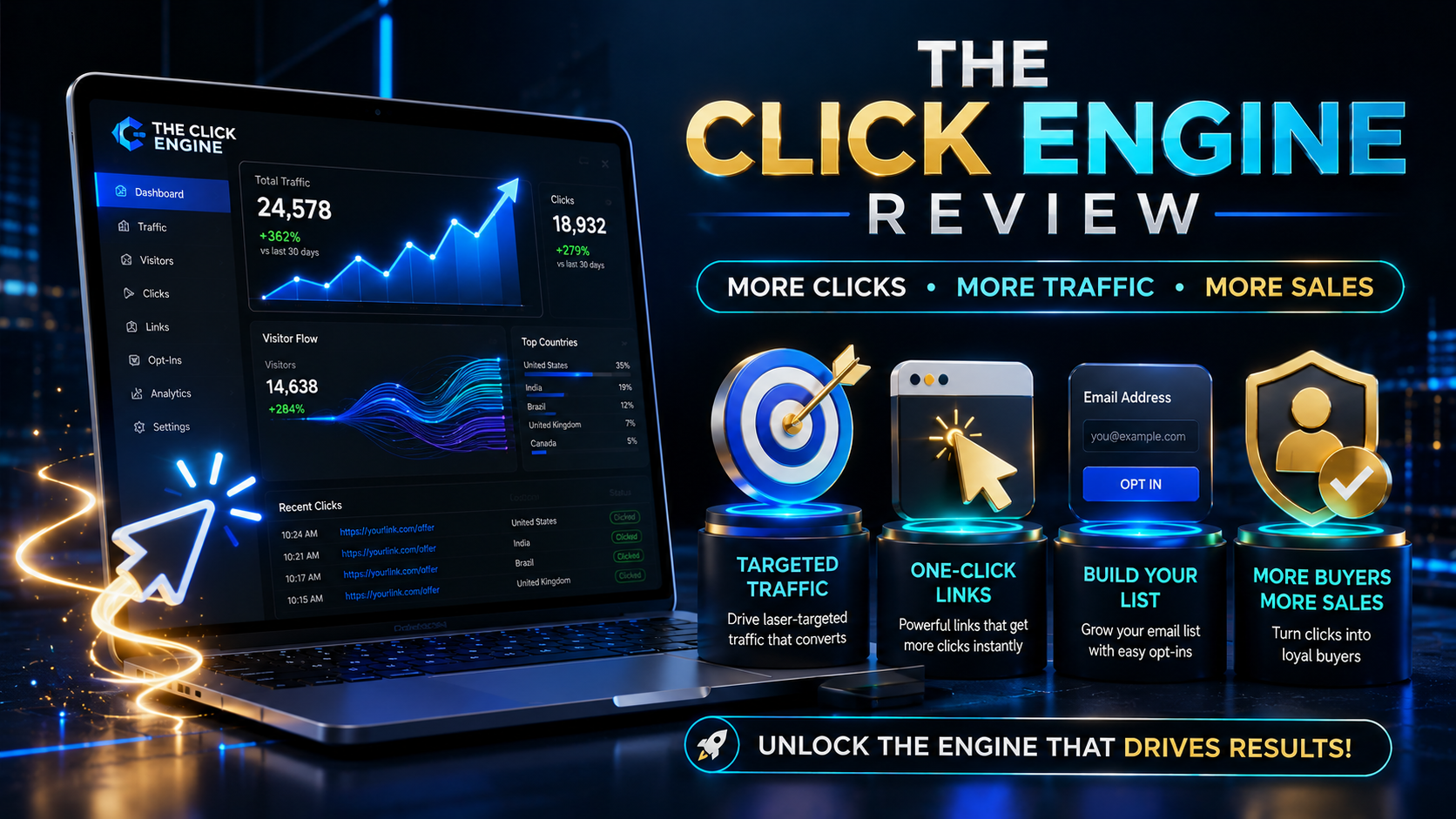
Looking to Get Real Buyer Traffic to Your Affiliate Offers?
Get instant access to The Click Engine and start driving targeted visitors to your funnels and pre-sell pages today.
Get Instant Access To The Click Engine 🔒 Access the Official Buyer Traffic System TodayIf you’ve been working in affiliate marketing for more than a few weeks, you probably already understand one uncomfortable truth: getting an offer is often easier than getting the right people to see it.
You can choose a promising product, create a landing page, write persuasive copy, add tracking, and prepare your follow-up emails. But without visitors, none of those assets can generate meaningful data.
And even when traffic arrives, there is another problem.
Traffic quality matters.
A visitor who lands on your page, looks around for a few seconds, and leaves without reading anything isn’t necessarily useful traffic. What most affiliate marketers really want is a visitor who is interested enough to read, scroll, click, opt in, or investigate the offer further.
That is the problem The Click Engine is designed to address.
In this The Click Engine Review, I’ll break down the traffic model, intended audience, setup process, key features, potential benefits, limitations, pricing considerations, bonuses, alternatives, and the situations where this type of traffic may or may not make sense.
The original testing experience behind this review focused on a straightforward affiliate marketing workflow: sending traffic to a pre-sell page and observing visitor behavior rather than simply looking at raw click volume.
The important distinction is that The Click Engine should not be viewed as a machine that automatically creates sales. There is no responsible reason to assume that every visitor will become a customer.
Instead, the more useful question is whether the system can provide relevant visitors with an existing familiarity with online marketing, digital products, funnels, and affiliate offers.
That makes this The Click Engine Review particularly relevant for marketers operating in the MMO and digital-product space.
If your goal is to find a simple additional traffic source for testing pages, offers, and lead-generation funnels, keep reading.
The Click Engine Review: Quick Overview
Before getting into the details, here’s the short version of this The Click Engine Review.
| Category | Details |
|---|---|
| Product | The Click Engine |
| Category | Buyer-focused traffic system |
| Main Purpose | Send traffic to a submitted promotional page |
| Primary Audience | Affiliate and online marketers |
| Strongest Fit | MMO, digital products and marketing offers |
| Typical Funnel | Offer → Pre-sell/Bridge Page → CTA |
| Lead Generation | Can be used with an opt-in funnel |
| Skill Level | Beginner to intermediate |
| Main Strength | Audience relevance and testing potential |
| Main Weakness | Not suitable for every niche |
| Best Approach | Use it as one part of a diversified traffic strategy |
| Sales Guarantee | No guarantee of individual sales should be assumed |
The central idea is relatively simple.
Instead of starting from scratch with paid advertising or waiting months for organic search traffic, marketers can submit a promotional destination and use an existing ecosystem to generate visitors.
That doesn’t remove the need for marketing.
Your offer still needs to be relevant. Your page still needs to be persuasive. Your CTA still needs to make sense. And your tracking still needs to tell you whether visitors are engaging.
That is why the best way to evaluate the platform is not simply to ask, “How many clicks will I get?”
A better question to ask: “Can this traffic help me test and improve my funnel with visitors who are relevant to my offer?”
What Is The Click Engine?
The Click Engine is positioned as a buyer traffic system that helps marketers promote a selected link to an audience familiar with online marketing and digital offers.
The basic process is built around submitting a page or promotional destination and allowing the system to expose that link through its ecosystem.
This differs from platforms such as Google Ads or Meta Ads, where marketers typically build campaigns around audience targeting, creative assets, bidding, budgets, and advertising rules.
The Click Engine is more straightforward in concept:
- You provide the destination.
- The system provides the traffic opportunity.
- You then have to convert that opportunity.
This distinction is important because the term “buyer traffic” can easily be misunderstood.
It does not mean every person who visits is guaranteed to purchase.
Instead, the positioning is based on the idea that the audience is already familiar with online-business offers, digital products, funnels, upgrades, and related marketing concepts.
For an affiliate marketer promoting a marketing tool, traffic product, funnel system, list-building solution, or similar offer, that audience alignment can be useful.
For an unrelated niche, the same traffic may not be nearly as valuable.
That’s one of the most important conclusions in this The Click Engine Review: audience-product alignment matters just as much as traffic volume.
Who Is The Click Engine Actually For?
The best candidates for The Click Engine are marketers whose offers naturally fit the online marketing ecosystem.
That may include:
- Affiliate marketing products
- Traffic-generation tools
- Funnel builders
- Email marketing software
- Lead-generation products
- Digital marketing courses
- DFY marketing systems
- Online business tools
- MMO products
- Digital products
- Marketing services
Why does this matter? Because the visitor already has some familiarity with the purchasing environment.
Someone who regularly investigates online marketing tools may understand what a sales page is, why a CTA exists, what an upsell is, and why an email opt-in might be useful.
That doesn’t guarantee a conversion. But it can reduce the mismatch between visitor expectations and the offer you’re presenting.
Who Should Consider The Click Engine?
This The Click Engine Review is most favorable toward marketers who fit several of these situations:
- You promote digital products.
- You work in affiliate marketing.
- Your offers target online marketers.
- You need additional traffic for testing.
- You want to test a pre-sell page.
- You are building an email list.
- You want an alternative to immediately spending heavily on paid ads.
- You have basic copywriting and funnel skills.
- You want another traffic source to complement your existing channels.
Who Should Probably Avoid It?
The system may be less appropriate if your business depends heavily on slow trust-building or specialized audience targeting.
Examples could include:
- Local service businesses
- Highly specialized B2B offers
- Medical or health-related services
- High-ticket consulting
- Offers requiring extensive education
- Products aimed at audiences outside the online marketing ecosystem
That doesn’t mean such businesses cannot use the system. It simply means the traffic model may not be the most natural match.
How Does The Click Engine Work?
The simplest way to understand The Click Engine is to think about it as a traffic placement system, not as a replacement for your marketing funnel.
A typical workflow looks like this:
- Choose an offer that fits the audience.
- Create a relevant landing or bridge page.
- Explain the offer clearly.
- Give visitors a reason to continue.
- Add a visible CTA.
- Submit the promotional link.
- Monitor incoming visitor behavior.
- Identify weak points.
- Improve your page or offer positioning.
- Continue testing.
The important part is step eight. Traffic itself isn’t the entire strategy.
Suppose 500 people visit your page and almost nobody clicks the CTA. You don’t necessarily know that the traffic source failed. Your headline might be weak. Your offer might not match the audience. The page might be too long. The CTA might be unclear. The promise might not connect with the visitor’s problem.
The traffic source gives you the opportunity to discover these problems. That is why the testing aspect is one of the stronger arguments in this The Click Engine Review.
My Testing Setup and What I Looked For
The supplied testing experience used a relatively simple setup instead of a complicated advertising stack.
A pre-sell page was created for a marketing-tools niche. The page included:
- A clear headline
- A short introductory section
- A primary CTA
- A second CTA further down the page
- A variation that included a lead-generation step
Two basic approaches were tested. The first directed visitors toward the offer. The second encouraged visitors to opt in for a quick resource before continuing.
The purpose wasn’t to claim a specific earnings result. Instead, the focus was on behavioral signals. The testing observations included:
- Scroll depth
- Bounce behavior
- Time on page
- CTA clicks
- Opt-in activity
- General engagement
This is a sensible way to evaluate traffic because raw visitor counts don’t tell the complete story. A thousand visitors who leave immediately may be less useful than a smaller number of visitors who actually read the page and interact with the funnel.
What Was Expected?
The testing approach went in with several reasonable expectations:
- First, some low-quality visits were expected because virtually every traffic source can contain visitors who don’t engage.
- Second, traffic behavior was expected to fluctuate while the link was being placed and rotated.
- Third, the offer was expected to perform better when it matched the interests of the audience.
Those expectations are important because they avoid one of the biggest mistakes in affiliate marketing: assuming that every traffic source should produce the same conversion rate regardless of the offer.
The Click Engine Review: Key Features
Instead of treating the product like a checklist of marketing buzzwords, let’s examine the practical purpose of the main features and capabilities described in the source material.
1. Link Submission Model
The basic model allows marketers to submit a promotional page and have it exposed through the system’s ecosystem. This removes some of the work associated with manually finding placements or creating a full paid advertising campaign.
For a beginner, that simplicity can be useful. You can focus more attention on your offer and landing page instead of spending all your time learning campaign-management software.
2. Compatibility With Bridge Pages
A bridge page can be an important part of the funnel. Rather than sending someone immediately to an affiliate sales page, you can first explain:
- What the product is
- What problem it addresses
- Who may benefit from it
- What makes it relevant
- What the visitor should do next
A well-structured bridge page can create a smoother transition between the traffic source and the affiliate offer. The testing experience described in the source material suggested that page quality had a meaningful impact on how valuable the incoming traffic felt.
3. Lead Generation Potential
The Click Engine isn’t limited to a direct-sale approach. A marketer can potentially send visitors to an opt-in page first.
This creates another possible conversion event. Instead of asking every visitor to purchase immediately, you can offer a genuinely useful resource and continue the relationship through appropriate email follow-up after obtaining permission. For affiliate marketers, this can be valuable because an email list can become a longer-term asset.
4. Consistent Testing Opportunity
Traffic spikes aren’t always useful for optimization. If visitors arrive in one large burst and then disappear, it can be difficult to compare page variations.
A more consistent traffic flow may make it easier to test headlines, CTAs, page layouts, lead magnets, offer positioning, copy, and funnel steps. This turns traffic into a learning tool rather than simply a source of visitors.
5. Bonus Resources
The offer also includes several bonus memberships and resources. These may provide additional marketing material, but they should be viewed as extras.
The primary reason to consider the product should be the traffic model. If the traffic isn’t appropriate for your business, a long bonus list won’t fix that problem.
The Click Engine Review: Traffic Quality and Buyer Intent
This is arguably the most important part of the entire The Click Engine Review. “Buyer traffic” sounds attractive, but marketers should never judge traffic quality based solely on a label. Instead, look for behavior:
- Scroll Behavior: Visitors who immediately leave provide limited information. Visitors who scroll through your content and reach important sections demonstrate stronger engagement. Scroll depth isn’t proof of buying intent, but it can help you distinguish between immediate bounces and genuine page consumption.
- CTA Interaction: Another useful signal is whether visitors interact with your calls-to-action. A visitor who reads your page and clicks a relevant CTA is demonstrating more engagement than someone who leaves without interacting.
- Opt-In Behavior: For list-building campaigns, opt-in activity can be especially useful. Someone willing to exchange an email address for a relevant resource has shown a measurable level of interest. Again, this isn’t a guarantee of future sales; it’s simply a stronger behavioral signal.
- Time on Page: Time on page should never be interpreted alone. Someone can leave a browser tab open without reading anything. But when time is considered alongside scrolling and CTA activity, it can become useful for understanding engagement.
- Offer Relevance: Perhaps the biggest factor is whether your offer belongs in front of the audience. If you’re promoting a marketing tool to people interested in online marketing, the relationship is obvious. If you’re promoting an unrelated product, the same visitor may have little reason to care.
This is why the The Click Engine Review should not be reduced to a simple “good traffic” or “bad traffic” conclusion—traffic quality is contextual.
What I Liked About The Click Engine
- Faster Testing: A traffic source gives you the opportunity to move from preparation into measurement quickly.
- Audience Intent: For marketers promoting MMO and digital marketing offers, an audience that already understands online purchases makes sense.
- Simple Funnels: A well-written bridge page can be enough to start learning how visitors respond, making the approach accessible to beginners.
- List-Building Potential: Using traffic for lead generation rather than direct sales gives marketers another way to measure value.
- Encourages Optimization: A steady stream of visitors encourages you to improve headlines, CTAs, and offer positioning.
What I Didn’t Like: Important Limitations
Key Limitations to Keep in Mind:
- The Traffic Isn’t Universal: If your offer doesn’t fit the online marketing ecosystem, you may not get the results you’re looking for.
- Limited Source Control: Unlike traditional ads, you’re accessing an existing ecosystem rather than building every targeting parameter yourself.
- Your Page Still Matters: Traffic cannot rescue a poor, confusing, or badly structured landing page.
- It Isn’t a Complete Brand Strategy: It should complement, not replace, SEO, content, and organic audience building.
- No Guaranteed Sales: Conversion rate depends on offer quality, landing page, price, and visitor intent.
The Click Engine Pricing: How Should You Judge the Value?
The Click Engine pricing is naturally one of the first things prospective buyers want to investigate. However, price alone doesn’t determine whether a traffic service is valuable.
The better question is what the traffic helps you accomplish. For example, the service could be more useful if it helps you test an offer faster, generate consistent visitor data, improve your bridge page, build an email list, identify better messaging, or validate an offer before investing heavily in advertising.
Because promotional pricing and terms can change, prospective buyers should confirm the current The Click Engine pricing directly on the official offer page before purchasing.
The Click Engine Bonuses
The supplied offer information lists eight bonus resources:
- Bonus #1 – Traffic Generation Club: Focused on traffic-generation concepts and marketing material.
- Bonus #2 – Affiliate Profits Club: Positioned around affiliate marketing and profit-focused strategies.
- Bonus #3 – eMarketersClub: An additional resource aimed at online marketers.
- Bonus #4 – Membership Marketers Club: Resources related to membership marketing and online business.
- Bonus #5 – Power Copy Club: Copywriting-focused material that may be useful when improving sales pages.
- Bonus #6 – Power Marketers Club: Additional marketing resources for online marketers.
- Bonus #7 – Wealth Upgrade Club: Positioned around online business and wealth-related topics.
- Bonus #8 – Web Profits Club: Additional resources focused on web marketing and online profits.
Evaluate the core traffic service first. If the traffic matches your audience, the bonuses add value; if not, eight bonuses won’t fix the fundamental mismatch.
The Click Engine Pros and Cons
Pros
- Designed around a buyer-oriented marketing audience
- Simple, beginner-friendly traffic model
- Potentially useful for affiliate marketers
- Can be used with lead-generation pages
- Useful for testing offers and bridge pages
- Can complement other traffic channels
Cons
- Not appropriate for every niche
- Less targeting control than major ad platforms
- Results depend heavily on funnel quality
- No guaranteed individual sales
- Shouldn’t be your only traffic source
- Doesn’t replace SEO or paid ads
Who Should Buy vs. Avoid The Click Engine?
Who Should Buy?
- Affiliate Marketers: Promoting digital marketing, traffic tools, funnel software, or MMO offers.
- Beginners Looking for Simplicity: Seeking an approachable way to start testing without complex ad setups.
- Funnel Builders & List Builders: Needing consistent traffic for bridge pages, lead magnets, and opt-ins.
- Experienced Marketers: Wanting to diversify traffic sources alongside SEO, paid ads, or social media.
Who Should Avoid?
- Anyone expecting guaranteed commissions, automatic sales, or zero-effort income.
- Marketers promoting offers unrelated to the digital marketing/MMO ecosystem.
- Writers or sellers looking for a replacement for SEO, paid advertising, or copywriting.
Is The Click Engine Legit?
The supplied information presents The Click Engine as a traffic service rather than a guaranteed-income opportunity. That distinction matters.
A legitimate evaluation should focus on measurable factors: relevance of traffic, visitor engagement, offer compatibility, landing-page performance, lead-generation results, and overall cost versus value. The testing experience reported visitor behavior that appeared more intentional than expected from generic low-cost traffic, but your individual results will depend on your specific funnel.
The Click Engine vs Other Traffic Models
| Traffic Model | Main Strength | Main Challenge |
|---|---|---|
| The Click Engine | Relevant marketing audience | Less granular targeting |
| Paid Social Ads | Detailed audience targeting | Testing can become expensive |
| Search Ads | Captures direct search intent | Competitive keywords cost more |
| SEO & Content | Long-term organic potential | Requires significant time |
| Solo Ads | Fast email-based exposure | Quality varies widely by list |
| Email List | Owned, direct audience | Takes time to build initially |
Frequently Asked Questions
Yes. The basic traffic model is relatively simple because you aren’t required to build a complicated paid advertising campaign, though basic landing page and offer knowledge is helpful.
Digital marketing products, affiliate offers, traffic systems, funnel tools, marketing software, and MMO-related products appear to be the most natural fit.
You need an appropriate destination for the traffic—such as a landing page, pre-sell page, bridge page, or lead-generation page.
Yes. You can direct traffic to an opt-in page before presenting an affiliate offer to build an email list.
The system is positioned around an audience familiar with online buying and marketing offers, but individual conversion depends on your page and offer.
No. No traffic platform can responsibly guarantee individual sales or conversion rates.
The Click Engine Review: Final Verdict
The Click Engine is best understood as a buyer-oriented traffic utility for the online marketing ecosystem. Its value depends heavily on the relationship between the traffic, your offer, your landing page, and your conversion strategy.
For an affiliate marketer who wants an additional source of potentially relevant traffic to test bridge pages, lead magnets, and MMO offers, The Click Engine can be worth testing.
Final Assessment: Use the traffic as an opportunity and a testing tool—not a guaranteed sales machine.
Ready to Test The Click Engine With Your Funnel?
Review the current offer, pricing, terms, and availability on the official page to start driving visitors today.
Check The Click Engine Official Offer Access Official Buyer Traffic SystemImportant Disclosure: This review is based on testing observations, traffic model analysis, and vendor-provided details. The Click Engine is a traffic service, not a guaranteed-income system. Individual earnings and conversion rates depend on offer quality, audience match, landing page copy, and execution.