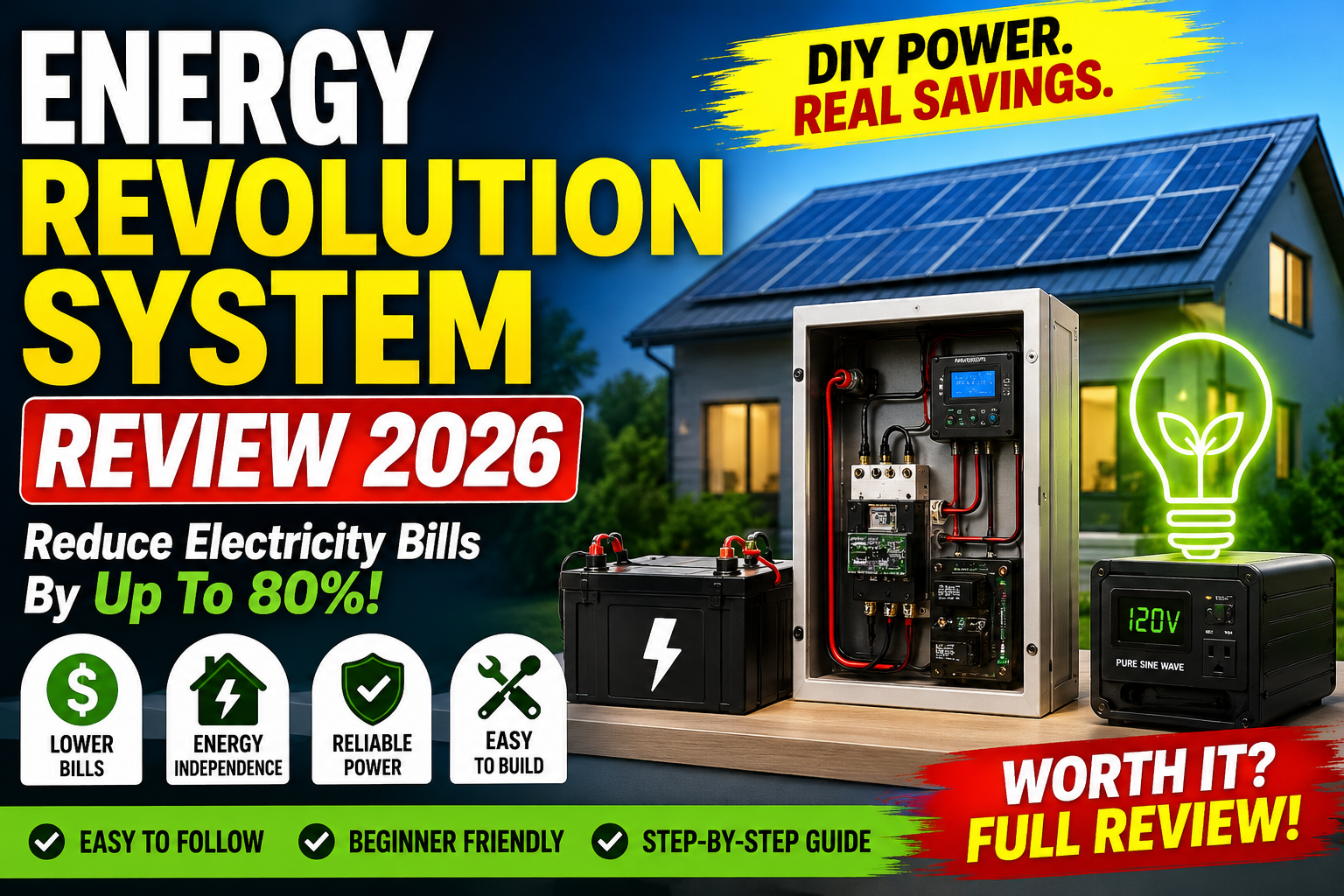
Electricity costs continue to rise across many regions, leaving homeowners searching for practical ways to reduce monthly utility expenses without investing tens of thousands of dollars in expensive renewable energy systems. As a result, DIY energy-saving solutions have become increasingly popular, and one product that has gained significant attention is the Energy Revolution System.
Unlike traditional solar panel installations or portable power stations, the Energy Revolution System is promoted as a step-by-step digital program that teaches users how to build an affordable home energy system while improving overall electricity efficiency. Its marketing claims suggest that homeowners could dramatically lower their energy bills through a combination of DIY power generation and smarter energy management.
However, bold promises often raise important questions.
- Is the Energy Revolution System legitimate?
- Can it really reduce electricity costs?
- Is it suitable for beginners?
- How much money should you realistically expect to save?
This comprehensive review answers those questions using a balanced, evidence-based approach. Rather than relying on promotional claims alone, we’ll examine how the system works, its key features, who it’s designed for, and the realistic expectations users should have before purchasing.
Whether you’re looking for a backup energy solution, exploring renewable energy alternatives, or simply trying to cut household expenses, this guide will help you decide whether the Energy Revolution System deserves a place in your home energy strategy.
Energy Revolution System Review – Quick Verdict
⭐ Quick Review Summary
A quick overview of the product before you decide.
| 🏆 Overall Rating | |
| 🎯 Best For | Homeowners, DIY enthusiasts, and preparedness-minded users. |
| 📘 Product Type | Digital DIY Energy Guide |
| 🛠 Installation | Self-built using the included step-by-step instructions. |
| 📚 Skill Level | Beginner to Intermediate. |
| 💵 One-Time Purchase | Yes — No recurring payments required. |
| ❌ Monthly Subscription | No monthly subscription or hidden recurring fees. |
| 🛡 Refund Policy | Available through the official vendor, subject to the current refund terms and conditions. |
🔒 Secure Checkout • 💳 One-Time Payment • 🛡 Satisfaction Guarantee
The Energy Revolution System is not a miracle machine that instantly eliminates your electricity bill. Instead, it serves as an educational DIY program that teaches users how to assemble a supplemental home energy setup while adopting smarter electricity-saving habits.
People willing to invest time, follow instructions carefully, and purchase the required hardware may see meaningful reductions in energy consumption over time. Those expecting a plug-and-play solution with guaranteed dramatic savings are likely to be disappointed.
What Is the Energy Revolution System?
The Energy Revolution System is a digital educational program that provides detailed instructions for building a compact home energy solution using commonly available components. Rather than selling a finished physical product, it offers downloadable materials that guide users through the design, assembly, and optimization process.
The program is designed to help users:
- Understand how household electricity works
- Build a small supplemental power system
- Reduce unnecessary energy waste
- Improve overall power efficiency
- Lower long-term electricity costs through smarter energy management
Unlike professional solar installations, which often require contractors, permits, and significant financial investment, this system focuses on affordability and hands-on learning.
Many homeowners appreciate this approach because it allows them to start small and expand their setup gradually as their knowledge and budget grow.
Why Has the Energy Revolution System Become Popular?
Several factors have contributed to the growing interest in DIY home energy systems.
Rising Electricity Prices
Energy costs have increased significantly in many parts of the world, making homeowners more interested in reducing dependence on traditional utility providers.
Growing Interest in Energy Independence
More families want backup power during outages and natural disasters without relying entirely on expensive generators.
Expensive Solar Installations
While rooftop solar systems offer long-term savings, their upfront costs remain out of reach for many households.
The Energy Revolution System positions itself as a lower-cost educational alternative that helps homeowners understand renewable energy principles before committing to larger investments.
What’s Included Inside the Program?
Although package contents may vary slightly depending on updates from the official publisher, the program generally includes several educational resources designed for DIY users.
Step-by-Step Digital Blueprint
The primary component is a downloadable guide that explains how to build a compact supplemental energy system using widely available materials.
The instructions are presented in a structured format, allowing users to progress through each stage without needing advanced engineering knowledge.
Illustrated Diagrams
Visual diagrams simplify the construction process by showing component placement, wiring concepts, and assembly sequences.
These illustrations help reduce confusion, particularly for beginners who learn better through visual examples.
Energy Optimization Guides
One of the strongest aspects of the program isn’t just building equipment—it’s learning how to use electricity more efficiently.
Users receive practical guidance on:
- Reducing standby power consumption
- Improving appliance efficiency
- Managing household energy loads
- Understanding electricity usage patterns
- Identifying hidden sources of wasted power
These improvements alone can contribute to noticeable energy savings even before completing the DIY build.
Maintenance Recommendations
The program also explains how to inspect and maintain the completed setup, helping users keep their system operating safely and efficiently over time.
Maintenance topics typically include:
- Routine inspections
- Component replacement
- Safety checks
- Performance optimization
- Troubleshooting common issues
What Makes the Energy Revolution System Different?
Many energy-related products focus exclusively on selling hardware.
The Energy Revolution System takes a different approach by emphasizing education first.
Instead of simply providing equipment, it encourages users to understand:
- How electricity flows
- How appliances consume power
- Where energy waste occurs
- How efficiency improvements affect monthly bills
- Which upgrades produce the best return on investment
This educational foundation helps homeowners make better long-term energy decisions, regardless of whether they eventually expand into larger renewable energy systems.
Who Created the Energy Revolution System?
The program is marketed as an educational resource developed for homeowners interested in reducing energy costs through practical DIY methods.
Rather than relying on proprietary technology or secret inventions, the materials compile commonly understood electrical principles into an organized learning system that’s easier for non-experts to follow.
This makes the program more comparable to a detailed home improvement course than a traditional consumer appliance.
Is It a Physical Product?
This is one of the most common questions prospective buyers ask.
The answer is no.
The Energy Revolution System is not shipped as a ready-made generator or complete energy device.
Instead, buyers receive digital materials explaining:
- What components are needed
- Where those components can typically be sourced
- How they fit together
- Safety considerations during assembly
- Best practices for long-term operation
Users are responsible for purchasing the physical hardware separately.
Because of this, the total project cost depends on:
- Component quality
- Local material prices
- Existing tools
- Desired system capacity
For many DIY enthusiasts, this flexibility is an advantage because they can customize the project according to their available budget.
How Does the Energy Revolution System Work?
One of the biggest misconceptions about the Energy Revolution System is that it functions as a ready-made machine that immediately powers your home. In reality, it is a structured DIY educational program designed to help users build a supplemental energy solution while learning how to optimize household electricity consumption.
Rather than relying on a single breakthrough technology, the program combines practical energy-saving principles, DIY construction guidance, and smart power management strategies into one complete learning system.
The process can generally be divided into four stages.
Stage 1: Learning the Fundamentals of Home Energy
Every successful DIY energy project starts with understanding how electricity works. Instead of assuming prior technical knowledge, the Energy Revolution System begins by teaching the basics in a simplified format.
The early lessons focus on helping users understand:
- Voltage and current
- Power consumption (watts and kilowatt-hours)
- Household electrical loads
- Energy efficiency
- Safe electrical practices
Understanding these concepts allows homeowners to make informed decisions before purchasing components or beginning construction.
Many users discover that they have been wasting electricity for years through inefficient appliances, unnecessary standby power, or poor energy management habits.
Simply identifying these issues can reduce monthly utility costs before any hardware is installed.
Stage 2: Planning Your DIY Energy Setup
Once users understand the fundamentals, the program guides them through planning a system based on their personal needs and budget.
Instead of promoting a one-size-fits-all design, the guide encourages customization.
Users are taught to evaluate factors such as
- Daily electricity usage
- Peak energy demand
- Available installation space
- Budget limitations
- Backup power requirements
This planning phase helps prevent overspending while ensuring the finished system aligns with realistic energy goals.
For example, someone who only wants emergency backup lighting will require a much smaller setup than someone hoping to offset the energy consumption of a workshop or home office.
Stage 3: Building the System
The core of the Energy Revolution System revolves around constructing a compact supplemental energy system using readily available components.
Although the exact design remains part of the paid program, users generally learn how to assemble components such as:
- Electrical wiring
- Power controllers
- Energy storage units
- Safety devices
- Structural supports
- Electrical connectors
The emphasis is on affordability and accessibility rather than specialized proprietary equipment.
Most materials can typically be purchased from:
- Local hardware stores
- Electrical supply shops
- Home improvement retailers
- Online marketplaces
This flexible approach allows users to upgrade or replace individual components over time without being locked into one manufacturer.
Stage 4: Optimizing Household Energy Usage
Building the system is only part of the overall strategy.
The program places equal importance on reducing unnecessary electricity consumption.
Users learn practical methods such as:
Reducing Phantom Power
Many electronics continue drawing electricity even while switched off.
Televisions
Gaming consoles
Phone chargers
Microwaves
Coffee makers
Smart home devices
These small energy drains accumulate over an entire year.
Simple adjustments can significantly improve efficiency.
Upgrading Lighting
Lighting remains one of the easiest areas to improve.
Replacing older bulbs with energy-efficient LED lighting can reduce lighting-related electricity consumption substantially while increasing bulb lifespan.
Smarter Appliance Scheduling
The guide also explains how to distribute energy usage more efficiently throughout the day.
Instead of operating multiple high-demand appliances simultaneously, homeowners can schedule usage to reduce peak demand and improve overall system efficiency.
Examples include:
- Laundry
- Dishwashers
- Workshop equipment
- Water pumps
- Battery charging
Better scheduling reduces stress on both household wiring and supplemental energy systems.
Improving Home Efficiency
Electricity savings are not only generated by producing power.
Reducing energy waste is equally important.
The program encourages improvements such as:
- Better insulation
- Weather sealing
- Efficient cooling
- Smart thermostats
- Proper ventilation
These upgrades reduce overall power requirements, allowing smaller energy systems to deliver better results.
Key Features of the Energy Revolution System
Although the program focuses heavily on education, it also offers several practical features that distinguish it from many other DIY energy guides.
Beginner-Friendly Instructions
One common concern among buyers is whether technical knowledge is required.
The program attempts to simplify complex electrical concepts using:
- Plain language
- Step-by-step lessons
- Illustrated diagrams
- Organized modules
- Logical progression
This educational approach makes the learning curve more manageable for beginners.
Downloadable Digital Access
Since the program is delivered digitally, buyers can typically access the materials immediately after purchase.
Advantages include:
- Instant delivery
- No shipping delays
- Easy downloads
- Mobile access
- Printable documents
Users can also revisit lessons whenever needed during construction.
Flexible Project Design
Rather than forcing everyone to build the same setup, the guide encourages customization.
Users can expand or modify their projects depending on:
- Budget
- Available space
- Household needs
- Future upgrades
This flexibility allows gradual improvements over time instead of requiring one large investment.
Educational Focus
Unlike products that promise unrealistic shortcuts, the Energy Revolution System emphasizes learning.
Topics commonly covered include:
- Understanding electricity bills
- Appliance efficiency
- Load calculations
- Safe wiring practices
- Maintenance planning
This knowledge remains valuable long after the project is complete.
Maintenance Guidance
A properly maintained system performs more reliably over time.
The guide includes maintenance recommendations covering:
- Routine inspections
- Cleaning
- Component testing
- Safety checks
- Replacement planning
Preventive maintenance helps improve long-term reliability while reducing unexpected failures.
Potential Benefits
Every homeowner has different goals.
Some want lower electricity bills.
Others prioritize emergency preparedness or learning technical skills.
The Energy Revolution System offers several potential benefits depending on how it is used.
Lower Electricity Costs
The most obvious benefit is the possibility of reducing household energy expenses.
Savings generally come from two combined factors:
- Supplemental energy production
- Improved energy efficiency
The exact amount varies based on:
- Household size
- Energy consumption
- Local utility rates
- Build quality
- User habits
There is no guaranteed percentage, but many users report gradual improvements after implementing multiple recommendations.
Greater Energy Awareness
Many homeowners never monitor how much electricity individual appliances consume.
The educational content encourages users to analyze:
- Daily usage
- Seasonal changes
- High-consumption devices
- Hidden energy waste
This increased awareness often leads to better purchasing decisions and smarter long-term energy management.
Hands-On Learning Experience
For DIY enthusiasts, the project offers an opportunity to develop practical skills.
Users gain experience with:
- Basic electrical concepts
- Planning projects
- Following technical instructions
- Problem-solving
- Equipment maintenance
These skills may prove useful for future home improvement projects.
Flexible Budgeting
Because users purchase components separately, they can control overall project costs.
Some people prefer starting with a basic setup before expanding later.
Others gradually upgrade individual parts as their budget allows.
This modular approach makes the project more accessible than large renewable energy installations requiring significant upfront investments.
Backup Power Possibilities
Depending on the final configuration, some users build systems capable of supporting selected household devices during temporary outages.
Typical backup applications might include:
- LED lighting
- Communication devices
- Small electronics
- Home office equipment
- Essential appliances
The exact capabilities depend entirely on system design, available storage capacity, and safe installation practices.
What Results Can You Realistically Expect?
This is perhaps the most important question for prospective buyers.
Marketing materials sometimes emphasize dramatic savings, but real-world performance depends on many variables.
Factors influencing results include:
- Household energy usage
- Quality of construction
- Component selection
- Installation accuracy
- Maintenance
- Daily energy habits
Most experienced DIY users recommend approaching the Energy Revolution System as a learning resource and supplemental energy project, not as a guaranteed replacement for conventional utility power.
Homeowners who combine the construction process with smarter energy management often experience the most meaningful long-term improvements.
Real User Experience: What Can Buyers Expect?
One of the biggest reasons the Energy Revolution System continues to attract attention is the growing number of discussions surrounding DIY energy independence. While every household is different, many users share similar experiences after working through the program.
It’s important to understand that results vary depending on factors such as electricity consumption, component quality, installation accuracy, climate conditions, and the amount of effort invested in the project. No DIY energy solution can guarantee identical outcomes for every homeowner.
Let’s look at what buyers can realistically expect.
Learning Experience
For many people, the greatest value of the Energy Revolution System isn’t simply building a supplemental power system—it’s gaining a better understanding of how electricity works.
Homeowners often discover:
- Which appliances consume the most electricity
- How standby power increases utility bills
- Ways to reduce unnecessary energy waste
- Practical methods for improving household efficiency
Even users who decide not to complete the entire project frequently report that the educational content helps them make smarter decisions about energy use.
Build Quality Depends on the User
Unlike factory-built equipment, a DIY project depends heavily on the person assembling it.
Users who carefully:
- Read every instruction
- Purchase quality components
- Follow safety guidelines
- Test the system thoroughly
are generally more likely to achieve reliable performance than those who rush through the process.
Patience plays a significant role in the final outcome.
Energy Savings Vary
One of the most common questions is:
“How much money can I actually save?”
The honest answer is that there is no universal number.
Savings depend on variables including:
- Household size
- Daily electricity usage
- Local utility rates
- Existing energy efficiency
- System capacity
- Seasonal weather
Some households notice modest improvements after implementing efficiency recommendations alone, while others see larger reductions after successfully integrating their DIY energy setup into selected applications.
The program should be viewed as one part of a broader energy-saving strategy rather than a guaranteed replacement for traditional electricity.
Time Commitment
Building any DIY energy project requires commitment.
Most users should expect to spend time on:
- Reading the guide
- Gathering materials
- Understanding diagrams
- Assembly
- Testing
- Maintenance
Individuals who enjoy home improvement projects generally find the process rewarding, while those seeking instant results may find it less appealing.
Common Advantages
After analyzing the program from a practical perspective, several strengths become apparent.
1. Affordable Entry into DIY Energy
Compared with professional renewable energy installations that can cost several thousand dollars, the Energy Revolution System provides a lower-cost educational starting point.
Instead of paying for complete installation, users gradually invest in materials based on their available budget.
2. Educational Value
Knowledge is one of the strongest long-term benefits.
The program teaches concepts that remain useful regardless of whether users eventually install:
- Solar panels
- Battery systems
- Backup generators
- Smart home technologies
Understanding household electricity helps homeowners make better purchasing decisions in the future.
3. Flexible Expansion
One significant advantage is flexibility.
Users are not locked into a fixed design.
As experience grows, many people choose to expand their projects by adding:
- Additional storage
- Better controllers
- Improved wiring
- Higher-capacity components
This gradual approach makes the project more manageable financially.
4. Encourages Better Energy Habits
Many electricity savings come from behavioral improvements rather than hardware alone.
The guide encourages habits such as:
- Monitoring electricity usage
- Turning off unnecessary devices
- Reducing standby power
- Scheduling heavy electrical loads
- Performing routine maintenance
These practices benefit virtually every household.
5. Immediate Digital Access
Because the program is delivered electronically, users can usually begin learning immediately after purchase.
There is no waiting period for shipping physical equipment.
This also allows users to review lessons multiple times while building the project.
Potential Drawbacks
No product is perfect.
Prospective buyers should also understand the limitations before making a purchase.
1. Not a Plug-and-Play Product
Perhaps the biggest misunderstanding is expecting a finished generator.
The Energy Revolution System provides instructions—not a completed machine.
Buyers must:
- Purchase materials
- Assemble components
- Test the setup
- Maintain the finished system
Those looking for an appliance that works immediately after opening the box may prefer professionally manufactured alternatives.
2. Hardware Costs Are Separate
The purchase price covers the educational materials.
Physical components must still be purchased separately.
Depending on the chosen design, users may need to buy:
- Wiring
- Electrical connectors
- Structural materials
- Storage components
- Safety equipment
- Power electronics
These additional expenses should be considered when planning the overall budget.
3. Requires Patience
DIY projects always involve a learning curve.
Although the guide is designed for beginners, users still need to dedicate time to:
- Reading instructions
- Understanding concepts
- Solving minor issues
- Following safety procedures
Those unwilling to learn basic technical skills may become frustrated.
4. Results Depend on Execution
Unlike commercial energy systems that are professionally installed, DIY success depends largely on build quality.
Poor workmanship can reduce efficiency or create safety risks.
Careful attention to detail is essential.
5. May Require Professional Assistance
Certain installations may require assistance from a qualified electrician, especially if users plan to connect supplemental power systems to household electrical infrastructure.
Professional advice is particularly important for ensuring:
- Electrical safety
- Code compliance
- Proper grounding
- Safe circuit integration
Is the Energy Revolution System Safe?
Safety should always come before cost savings.
Electricity can be dangerous when handled improperly, regardless of which DIY guide is used.
The Energy Revolution System emphasizes responsible construction practices, but users remain responsible for ensuring their projects comply with local regulations and safe electrical standards.
Basic safety recommendations include:
- Never overload electrical circuits.
- Use properly rated cables and connectors.
- Install appropriate fuses and breakers.
- Keep electrical equipment dry and protected.
- Inspect components regularly.
- Disconnect power before performing maintenance.
- Consult a licensed electrician whenever necessary.
Treat the project as a learning experience that requires careful planning rather than a shortcut to free electricity.
Is the Energy Revolution System Worth the Price?
When evaluating value, it’s important to separate the cost of the digital program from the cost of the physical project.
The digital guide itself is generally positioned as an affordable educational resource compared to large renewable energy investments. However, completing the project will require additional spending on components, tools, and safety equipment.
For buyers who enjoy DIY projects and want to build practical skills while exploring energy-saving methods, the combined investment may offer good value. For those seeking an instant, maintenance-free solution, professionally installed systems or ready-made backup power products may be a better fit.
The key question isn’t simply “How much does it cost?” but “Will I use what I learn?” Homeowners who actively apply the lessons on energy efficiency and responsible power management are more likely to benefit over the long term.
Who Should Buy the Energy Revolution System?
The Energy Revolution System isn’t designed for everyone. It’s best viewed as a learning platform combined with a DIY project, making it more suitable for people who enjoy hands-on work and want greater control over their household energy use.
Before purchasing, it’s worth considering whether your expectations align with what the program actually offers.
Ideal for Homeowners Looking to Reduce Energy Costs
If your monthly electricity bill continues to increase, the Energy Revolution System can serve as a practical starting point for understanding where energy is being used and how to reduce unnecessary consumption.
Instead of relying solely on expensive renewable energy systems, homeowners can begin with a smaller investment while learning valuable energy management skills.
The program may be especially beneficial for those who:
- Want to lower long-term electricity expenses.
- Enjoy learning practical home improvement skills.
- Prefer gradual upgrades over large upfront investments.
- Are interested in renewable energy concepts.
- Have space for a small DIY project.
Great for DIY Enthusiasts
People who enjoy building, repairing, and improving things around the home often appreciate the educational nature of the program.
The Energy Revolution System encourages users to:
- Learn by doing.
- Understand basic electrical principles.
- Build confidence with technical projects.
- Expand their knowledge over time.
For hobbyists, the project itself can be just as rewarding as the potential energy savings.
Useful for Preparedness-Minded Families
Many homeowners today want additional resilience during unexpected power outages.
While the Energy Revolution System should not be viewed as a complete emergency power solution, it may help users explore supplemental energy options that support essential devices during temporary interruptions, depending on how their system is designed and installed.
Preparedness-focused users often value:
- Learning about backup power.
- Understanding energy storage concepts.
- Increasing household self-reliance.
- Reducing dependence on a single power source.
Who May Want to Skip It?
Just as important as knowing who should buy the program is understanding who probably shouldn’t.
People Looking for Instant Results
If you’re expecting to purchase a device that immediately lowers your electricity bill without any effort, this program may not meet your expectations.
The Energy Revolution System requires:
- Time
- Learning
- Planning
- Component sourcing
- Assembly
- Ongoing maintenance
Those seeking convenience may be happier with professionally installed energy systems.
Users Uncomfortable with DIY Projects
Although the guide is designed for beginners, it still requires basic problem-solving and a willingness to follow technical instructions.
If you dislike:
- Building projects
- Reading diagrams
- Working with tools
- Learning new technical skills
then a ready-made commercial solution may be a better investment.
Renters with Limited Modification Options
Renters often face restrictions on making electrical or structural modifications.
Before beginning any project, it’s important to review lease agreements and obtain permission where necessary.
People Seeking Guaranteed Savings
No energy program can promise identical results for every household.
Electricity savings depend on many variables, including:
- Household consumption
- Local utility rates
- System design
- Installation quality
- Energy habits
Approach the program as an educational investment rather than a guaranteed financial outcome.
Energy Revolution System vs. Traditional Alternatives
To understand where the Energy Revolution System fits, it’s helpful to compare it with other common energy solutions.
⚖️ Product Comparison
See how the Energy Revolution System compares with other popular energy solutions.
| Feature |
⭐ Recommended Energy Revolution System |
Portable Solar Generator | Rooftop Solar System |
|---|---|---|---|
| 💰 Initial Cost | Low to Moderate | Moderate | High |
| 🔧 Installation | DIY | Ready to Use | Professional |
| 📚 Learning Opportunity | Excellent | Limited | Limited |
| 📈 Expandable | Yes | Limited | Yes |
| 🛠 Maintenance | User Managed | Low | Professional |
| 👨🔧 Suitable for Beginners | Yes, with effort | Yes | Yes |
| 🏠 Large Household Power | Limited | Limited | Excellent |
| 🚀 Long-Term Flexibility | High | Moderate | High |
🏆 Which Option Offers the Best Value?
If you’re looking for a cost-effective, hands-on DIY solution with strong long-term flexibility, the Energy Revolution System stands out as an excellent choice. For users who prefer plug-and-play convenience or whole-home energy production, other options may be a better fit depending on their goals and budget.
👉 Check the Official OfferFrequently Asked Questions
Does the Energy Revolution System really work?
The program provides educational materials and DIY instructions rather than a finished energy device. Users who carefully follow the guidance, purchase suitable components, and improve their energy habits may reduce electricity consumption, but results vary depending on individual circumstances.
Is the Energy Revolution System a scam?
The program itself is a legitimate digital educational product. However, buyers should avoid unrealistic expectations created by aggressive marketing. Purchasing through the official source helps ensure access to genuine materials, customer support, and any applicable refund policy.
Do I need electrical experience?
No advanced engineering knowledge is typically required, but users should be willing to learn basic electrical concepts, follow safety guidelines carefully, and seek professional assistance whenever necessary.
Can beginners build the system?
The program is intended to be beginner-friendly, using step-by-step instructions and diagrams. However, patience, attention to detail, and safe working practices remain essential throughout the project.
Does it replace solar panels?
No.
The Energy Revolution System is better viewed as a supplemental DIY energy project rather than a replacement for professionally installed solar photovoltaic systems.
Is there a monthly subscription?
The core program is generally sold as a one-time purchase, although optional upgrades or bonus materials may be available depending on the seller.
Can it power an entire home?
Most DIY supplemental energy systems are designed to support selected applications rather than supplying every electrical load in a modern household. Actual performance depends on system capacity, component quality, and safe installation.
Final Verdict: Is the Energy Revolution System Worth It in 2026?
The Energy Revolution System occupies a unique position in today’s growing DIY energy market. Instead of selling a plug-and-play generator or promising unrealistic shortcuts, it focuses on teaching homeowners how to better understand electricity, improve energy efficiency, and build a supplemental power solution using commonly available components.
Its greatest strength lies in education. By combining practical guidance with structured lessons on energy management, the program empowers users to make more informed decisions about their electricity consumption and long-term energy strategy.
That said, success depends heavily on the user’s commitment. Building a DIY system requires time, careful planning, and adherence to safety practices. It is not an instant solution, nor should it be viewed as a guaranteed way to eliminate electricity bills.
For homeowners who enjoy learning new skills, appreciate hands-on projects, and are willing to invest effort into improving energy efficiency, the Energy Revolution System can provide meaningful value. Those looking for a maintenance-free, professionally installed solution may find traditional solar systems or commercial backup power products more suitable.
Ultimately, the Energy Revolution System is best considered a practical educational resource that can help motivated users take the first steps toward greater energy awareness and increased household independence.
🏆 Final Verdict
Who should consider this product—and who may want to explore other options.
✅ Best For
- ✓Homeowners interested in lowering electricity costs over time.
- ✓DIY enthusiasts who enjoy building practical projects.
- ✓Families exploring energy preparedness and self-reliance.
- ✓Individuals who enjoy learning valuable technical skills.
- ✓Budget-conscious users seeking a gradual path toward energy independence.
❌ Not Ideal For
- ✕People expecting instant plug-and-play results.
- ✕Users unwilling to complete a DIY project.
- ✕Those seeking guaranteed electricity bill reductions.
- ✕Homeowners wanting a fully certified, professionally installed renewable energy system.
⚡ Ready to Learn More?
If you’re comfortable with a DIY approach and want to explore an affordable way to learn about home energy systems, this guide may be worth considering. Review the official details, compare package options, and decide whether it aligns with your goals.
👉 Visit the Official Website